GET YOUR FREE SMART MOBILE CARD MACHINE

Merchant Account Fees Comparison Guide for UK Businesses
8 min read
1560 words
In today's competitive UK marketplace, understanding merchant account fees is more than a financial necessity, it's a strategic advantage. Whether you're a small retailer or a high-volume eCommerce store, the costs you incur for accepting card payments can directly impact your bottom line. Yet, many business owners focus only on the headline transaction rate without considering the array of hidden fees and contractual terms that can double their actual costs.
This guide breaks down the key types of merchant account fees, compares leading UK providers, highlights hidden costs, and offers actionable strategies to optimise your payment processing expenses.
Understanding Merchant Account Fees
Merchant account fees are the charges businesses pay to process card transactions. These fees can include a mix of fixed monthly charges, per-transaction rates, and occasional one-off costs. They are set by merchant service providers, often influenced by card network interchange fees, operational costs, and value-added services provided. Understanding these fees means recognising that they cover not just transaction processing, but also fraud monitoring, compliance requirements, and customer support infrastructure. For example, a provider offering 24/7 support and advanced fraud detection might charge slightly higher rates, but those services could prevent costly disputes and chargebacks in the long run.
The biggest mistake merchants make is focusing only on the headline rate. Contract terms and hidden fees can easily double your costs.
— UK Payments Consultant, The Payments Guy Podcast
In the UK as of 2025, credit card transaction fees typically range from 0.7% – 3.4% for in-person payments, while debit cards often cost between 0.4% – 1.7% per transaction. Providers may offer bespoke rates for high-volume merchants, sometimes as low as 0.75%. Keep in mind that these rates can vary based on factors such as business type, average transaction value, and risk profile.
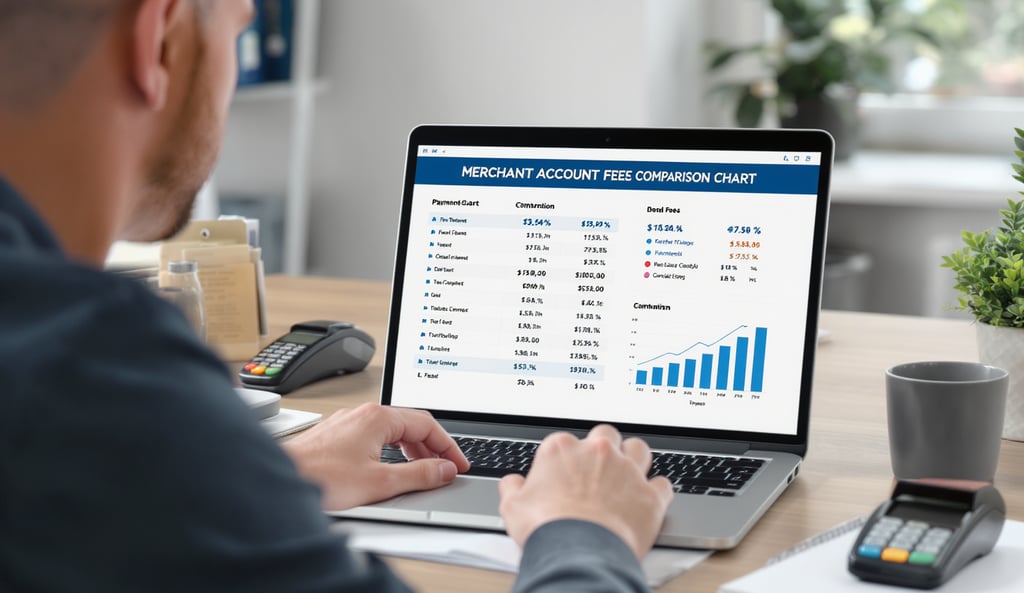

As seen in the table above, flat-rate providers like Square and SumUp offer simplicity and transparency, while traditional providers can provide lower bespoke rates for high turnover businesses but often with more complex fee structures. This complexity can sometimes result in savings for larger merchants but may be confusing or costly for smaller businesses without dedicated financial oversight.
Breaking Down Standard Fees
Most UK merchant accounts include several standard charges:
Merchant Discount Rate (MDR): Percentage of each transaction.
Monthly Service Fees: Typically £10–£30.
Card Machine Rental: £15–£25/month.
Setup Fees: Sometimes £50–£100, though often waived.
These fees are straightforward and usually disclosed upfront. However, they only tell part of the story. For example, the MDR is calculated on gross transaction value, meaning refunds or reversals may not always be credited back in full. Monthly service fees generally cover account maintenance, reporting tools, and access to customer service, but their value can differ widely between providers. Card machine rental costs may vary depending on device sophistication, portable wireless terminals often cost more than basic countertop models. Setup fees, while sometimes waived during promotional periods, can still apply if you require bespoke configurations or integrations with existing POS systems.
Identifying Hidden Costs
Hidden fees can significantly inflate your payment processing expenses:
Chargeback Fees: £15–£25 per occurrence.
Refund Fees: Flat fee or percentage.
Early Termination Fees: Contract buyout charges.
Cross-border Fees: 1–3% for international cards.
PCI Compliance Fees: Annual £30–£50.
Non-qualified Transaction Surcharges: Higher rates for corporate or rewards cards.
These charges often appear in the fine print and can catch businesses off guard. For instance, cross-border fees apply even if the customer is physically present but uses a card issued abroad. PCI compliance fees are intended to cover security audits and certification but may be avoidable if you self-certify and meet all standards. Non-qualified transaction surcharges typically hit when your customer uses a premium card outside standard interchange categories, increasing your per-transaction cost unexpectedly.
AI-driven payment processing is reducing interchange costs by optimising transaction routing and lowering fraud risk.
— Swipesum Payment Insights, Industry Report 2025
Spotting Hidden Fees Before You Sign
If you've just reviewed a provider's headline rate, pause and ask for a full fee schedule. Many UK merchants discover cross-border or PCI compliance charges only after they're locked into a contract. Our team at https://freepaymentconsulting.com/ can help you audit offers before you commit. Asking direct questions about all potential fees, including rare scenarios, can prevent unpleasant surprises.
Comparing UK Providers in 2025
When comparing providers, consider more than just rates:
Worldpay: Best for high turnover merchants seeking bespoke rates.
Barclaycard: Strong fraud protection, but higher early termination fees.
Clover: Integrated POS solutions with moderate flat rates.
Square & SumUp: Transparent, flat-rate pricing suitable for small businesses.
Providers like Square and SumUp have disrupted the market by eliminating many hidden fees, offering simplicity for startups and microbusinesses. Worldpay and Barclaycard, while potentially more expensive for small merchants, can deliver advanced reporting tools, multi-currency support, and tailored fraud prevention systems that benefit larger, complex operations. Clover stands out for businesses that want an all-in-one POS ecosystem, while Square and SumUp excel in fast setup and low entry barriers. In 2025, competition among these providers has intensified, leading to more promotional offers and flexible contracts.
Strategies to Minimise Costs
Negotiate Bespoke Rates: Especially if your annual card turnover exceeds £75,000.
Bundle Services: Some providers offer discounts when you integrate POS, online gateways, and mobile payments.
Audit Monthly Statements: Identify and challenge unexpected charges.
Leverage Fintech Solutions: Flat-rate models can be cost-effective for low to medium turnover businesses.
Negotiating rates can be particularly effective if you can demonstrate consistent volume or low risk. Bundling services may not only reduce fees but also simplify vendor management. Regular audits of monthly statements can uncover billing errors or misapplied fees issues that can be corrected to recover costs. Fintech providers often offer predictable pricing models, reducing the complexity of managing fluctuating MDRs.
Industry Trends Shaping Fees
AI & Automation: Increasingly used to reduce fraud and optimise transaction routing.
Regulatory Pressure: UK Payment Systems Regulator pushing for clearer fee disclosures.
Fintech Competition: Square, SumUp, Stripe driving transparency.
Omnichannel Integration: Unified fee structures across online, in-store, and mobile payments.
These trends suggest that transparency and tech-driven optimisation will be key in the coming years. AI tools can analyse transaction patterns in real time, routing payments through the most cost-effective channels. Regulatory changes may require providers to present clearer, standardised fee breakdowns, making comparisons easier for merchants. The growing demand for omnichannel solutions means providers must offer consistent rates regardless of sales channel, reducing administrative complexity.
Turning Trends into Savings
Understanding industry shifts is powerful, but applying them to your unique business is where real savings happen.
See how we at https://freepaymentconsulting.com/ can tailor these strategies to your operations. For example, adopting omnichannel payment platforms could streamline your fee structures while enhancing customer experience.
Implementation Guide for Businesses
Assess Your Volume: Know your average monthly card turnover.
List Your Payment Channels: In-person, online, mobile.
Request Full Fee Schedules: Include hidden fees.
Compare at Total Cost Level: Avoid focusing only on transaction rates.
Pilot New Providers: Test service quality before full migration.
Taking a structured approach to implementation can prevent costly mistakes. For example, piloting a new provider with a subset of transactions allows you to evaluate not just costs, but also customer service responsiveness and settlement speed. Comparing at total cost level means factoring in all recurring and one-off charges over a year, not just MDR. Documenting your payment channels ensures you choose a provider that can support your operational needs without costly add-ons.
Negotiating bespoke rates based on your turnover can save high-volume merchants thousands annually.
— Expert Market UK, Merchant Accounts Guide 2025
Conclusion
Merchant account fees are more than just a headline rate they're a complex mix of visible and hidden charges that can shape your profitability. By understanding the full landscape of standard and hidden fees, comparing providers holistically, and leveraging negotiation and fintech alternatives, UK businesses can significantly reduce costs. For instance, a small retailer could save hundreds per year by switching to a flat-rate provider, while a high-volume eCommerce store might save thousands through tailored MDR negotiations.
The future of payment processing in the UK is leaning toward transparency, automation, and integrated solutions. Whether you choose a traditional merchant account with bespoke rates or a flat-rate fintech provider, the key is to assess your needs carefully and make informed decisions. Regularly revisiting your merchant account agreements ensures you remain competitive as market rates and technologies evolve.
Taking the time to analyse your current and potential providers could save you thousands annually and position your business for smoother, more cost-effective transactions in 2025 and beyond. In a landscape where margins are tight, optimising payment processing isn't just about saving money; it's about creating a resilient, scalable foundation for future growth.
GET THIS SMART CARD MACHINE FOR FREE WITH NO MONTHLY RENTAL, NO MINIMUM MONTHLY SERVICE CHARGES OR PCI FEES


SPECIAL OFFER
Free Consulting
Expert advice for your business needs, save and succeed today.
contact
info@freepaymentconsulting.com
023 8111 2209
© 2025. All rights reserved.
contact form